In 1944, she married Moshe Gillis, a nature teacher, and the couple settled in Kfar Avraham near Petah Tikva. Early in her career, she served as a remedial teacher at the Amishav transition camps (Ma'abarot). Her academic journey culminated in 1985 when she earned a Ph.D. in Special Education and Hebrew Reading Instruction. A pioneering educator and researcher, she founded the Hadad Center for Dyslexia Research in 1986.
In March 1992, she established the Joseph Carlebach Institute for Modern Jewish Thought and Education. Created in collaboration with the University of Hamburg, the Institute commemorates the life and legacy of her father, Rabbi Dr. Joseph Zvi Carlebach (1883-1942), his family, and the Jewish community of Hamburg-many of whom perished in the Holocaust.
Over a career spanning nearly four decades, Prof. Dr. Miriam Gillis-Carlebach was deeply engaged in academic research and teaching. She authored and edited numerous works on the biographies of Rabbi Dr. Joseph Carlebach and Lotte Carlebach, the history of the Carlebach family, the Jewish communities of Hamburg and Altona, Holocaust education, and special education. In recognition of her significant contributions, she was honored with numerous awards including: Honorary Senator of Hamburg University (1995), Honorary Doctorate from Oldenburg University (2009), German Federal Cross of Merit [Bundesverdienstkreuz] (2008), and Medal for Art and Science from the City of Hamburg (2017).
The Institute was founded in March 1992 in honor of Joseph Zwi Carlebach, the last Chief Rabbi of the Hamburg Jewish community. This was a joint academic initiative in partnership with the Joseph Carlebach Workgroup of the University of Hamburg and the Institute for the History of the German Jews.
In accordance with the partnership agreements, the Institute organized eleven International Carlebach Conferences and coordinated long-term academic cooperation programs.
These included an annual student seminar conducted in collaboration with the University of Magdeburg, held regularly for twenty years between 1997 and 2017.
From its founding until 2015, the Institute was led by its founder, Prof. Dr. Miriam Gillis-Carlebach. In May 2015, the directorship was assumed by Prof. Dr. George Yaakov Kohler.
Joseph Zvi Carlebach (1883-1942) was born in Lubeck into a distinguished Orthodox rabbinic family.
In 1910, he earned a Doctor of Philosophy degree from the University of Heidelberg, and in 1914, he completed his studies at the Rabbinical Seminary in Berlin.
He served as a senior teacher in Jerusalem (1905-1907) and in Berlin (1908-1915). During World War I, he held the position of Head of the Jewish Real Gymnasium in Kovno. In 1921, he was appointed Director of the Talmud Torah school and later became the Chief Rabbi of the Jewish communities in Altona and Hamburg.
Joseph Carlebach was a prolific writer, publishing numerous books and articles in the contemporary Jewish press in Germany. His first article appeared in Der Israelit in July 1903, and his final article was published in the Hamburger Familienblatt in October 1938.
Volume III of Carlebach's selected writings (G. Olms, 2004) includes a comprehensive list of his published works and manuscripts.
Rabbi Joseph Carlebach served as Chief Rabbi of Hamburg and Schleswig-Holstein until his final day. He perished along with his wife, Lotte, and their three young daughters in March 1942 in the Bikernieki Forest near Riga.
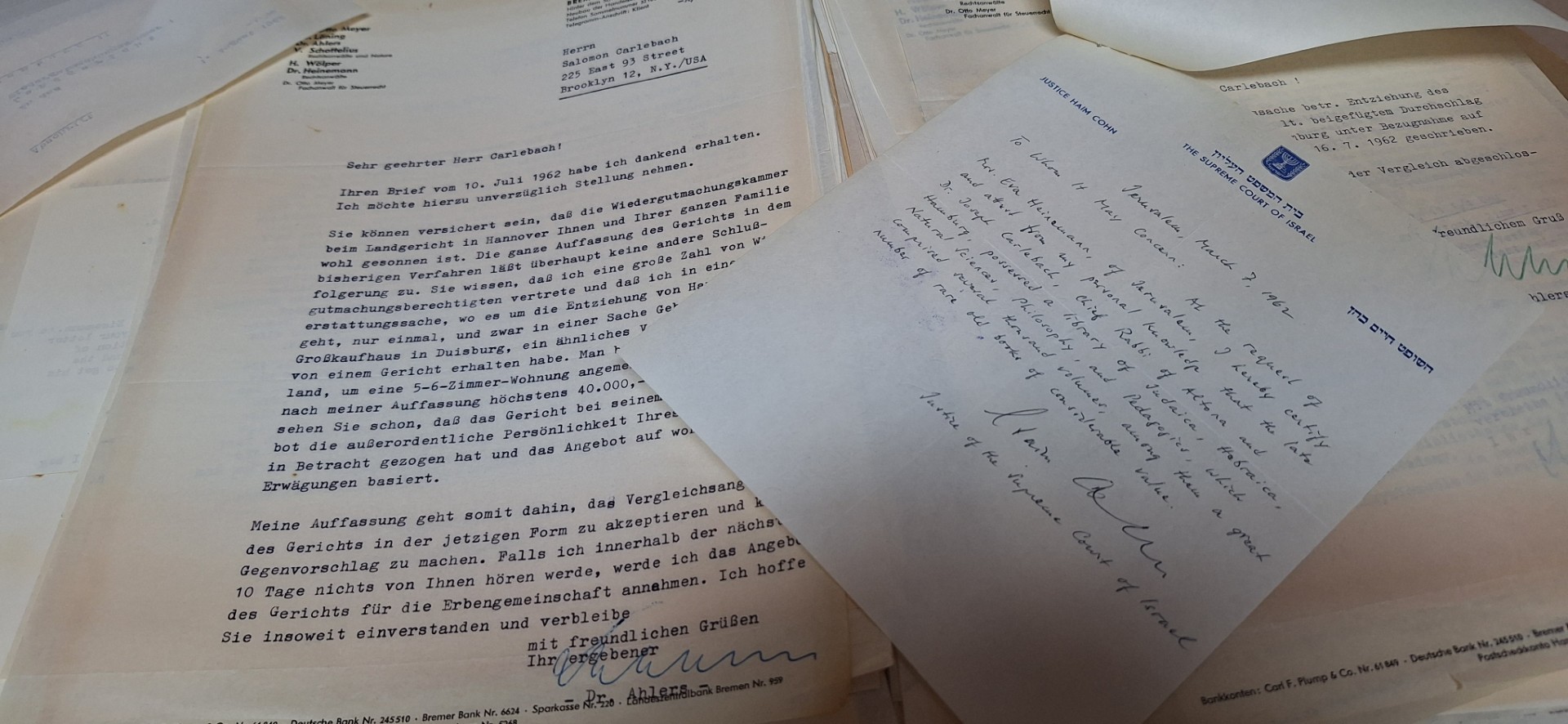
This series comprises materials personally assembled and preserved by Miriam Gillis-Carlebach over several decades. It includes handwritten and typed documents, correspondence, photographs, and related documentation concerning Joseph and Lotte Carlebach family.
The collection is organized into two complementary sections:
Personal and Family correspondence
The collection features the bulk of Joseph Carlebach's private correspondence, documenting his rabbinic and educational leadership in Kovno, Altona, and Hamburg. It also includes records of his tenure as secretary of the Freie Vereinigung fur die Interessen des orthodoxen Judentums.Publications, manuscripts
--
Microfilm Collection Copies
The Microfilm copies collection contains manuscripts, letters, biographical and family papers. The project was coordinated in 1976 by the Leo Baeck Institute (New York), which holds a duplicate copy of these records.
The archive's foundation lies in the Rabbi Dr. Ephraim Carlebach Collection. Following the family's immigration to Israel in March 1936, these records were meticulously preserved and later donated to the Joseph Carlebach Institute (JCI) between 1996 and 1998. This comprehensive series features personal papers, rabbinic manuscripts, and family documentation from Rabbi Alexander S. Adler, Rabbi Dr. Salomon Carlebach, and Rabbi Dr. Emanuel Carlebach, alongside records from the Wilhelm and Miriam Cohn family. The collection is further enriched by the papers of the third generation-including Esriel and Cilly Carlebach-representing the children of the primary creators. To provide a broader academic context, the archive includes complementary scholarly materials and writings by Dr. Moritz Stern (1864-1939), Rabbi Joseph H. Hacohen (1850-1948), and Rabbi Dr. Michael Cahn (1849-1920).